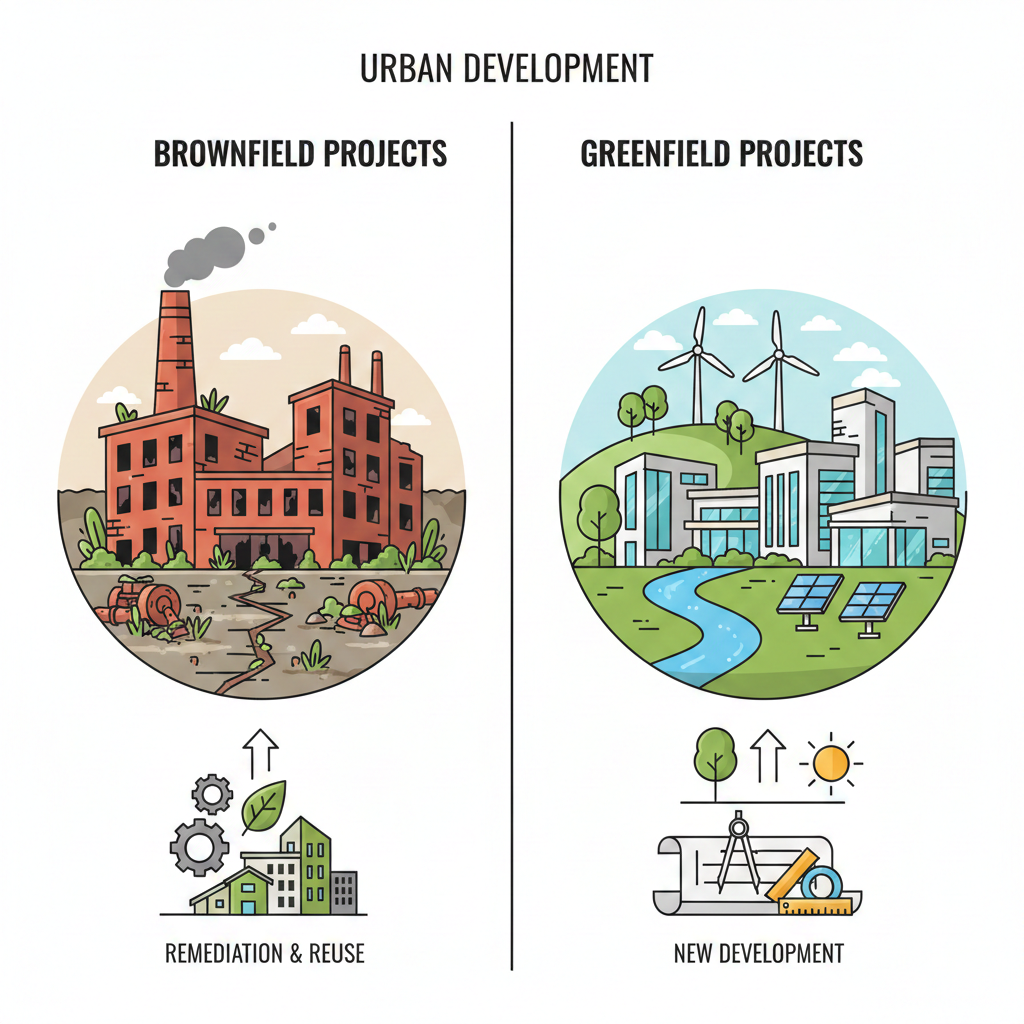
The software development landscape is experiencing a fundamental shift with AI-powered coding assistants, but their impact is far from uniform. A critical distinction is emerging: AI excels dramatically at brownfield development while struggling with true greenfield innovation. This asymmetry reveals something profound about both the nature of AI capabilities and the essence of software creativity.
Understanding the Divide
Brownfield projects involve working within established systems—modifying WordPress sites, extending Rails applications, integrating with existing APIs, or building features atop proven frameworks. These projects operate within known constraints, established patterns, and well-documented ecosystems.
Greenfield projects require creating novel architectures, designing new system paradigms, making foundational technology choices, and solving problems without established patterns. They demand vision about what should exist, not just knowledge of what does exist.
Why AI Dominates Brownfield Development
1. Pattern Recognition at Scale
AI models have ingested millions of WordPress plugins, React components, and Django applications. When you ask an AI to “add a contact form to my WordPress site” or “create a Stripe checkout flow in Next.js,” it’s drawing from thousands of similar implementations it has seen during training.
The AI isn’t truly understanding your business problem—it’s recognizing that your request maps to established patterns it has encountered countless times. This is perfect for brownfield work where you want standard solutions.
Example: Ask AI to implement authentication in a Laravel application, and it will generate code following Laravel’s conventions, using Eloquent models, middleware patterns, and session management exactly as the framework intends. It has seen this pattern executed thousands of times and can reproduce it reliably.
2. Framework Fluency
Modern frameworks like WordPress, Django, Rails, or Express exist precisely because they’ve solved common problems in standardized ways. AI models have extensive exposure to these solutions. They “know” that:
- WordPress uses hooks and filters
- React components should manage state predictably
- RESTful APIs follow specific conventions
- Database migrations should be reversible
When working within these systems, the AI is operating in its comfort zone—established territories with clear rules, extensive documentation, and countless examples.
3. Constraint as Advantage
Paradoxically, the constraints of brownfield projects make AI more effective. When you say “add this feature to my existing Express API,” you’ve already made the crucial decisions: the technology stack, architectural approach, coding conventions, and system boundaries. The AI just needs to execute within those parameters.
These constraints dramatically reduce the solution space. Instead of infinite possibilities, there are maybe a dozen reasonable approaches, all of which the AI has likely encountered.
4. Documentation-Rich Ecosystems
Established systems have extensive documentation, Stack Overflow answers, GitHub repositories, and tutorial content. AI models trained on this corpus effectively have “studied” these systems intensively. They can reference this implicit knowledge when generating code.
Why Greenfield Projects Resist AI
1. The Vision Problem
Greenfield projects begin with a fundamental question AI cannot answer: “What should we build?”
Human developers don’t just write code—they envision systems that don’t yet exist. They imagine user experiences, anticipate business needs, and conceptualize architectures that solve problems in novel ways. This requires:
- Understanding unstated business objectives
- Anticipating future requirements and scale
- Making value judgments about tradeoffs
- Synthesizing disparate concerns into coherent design
Example:
When designing a new Web Server Application Architecture , a human architect must decide: What if you could design your application’s behavior without the overhead of an interpreting framework? What if you could just declare what you want and have a server execute it at near-machine speed? This isn’t a coding question — it’s a question about system architecture , user expectations, consistency requirements, and future extensibility. The AI hasn’t seen the specific blueprint architecture system before because it doesn’t exist yet.
2. Novel Problem Spaces
AI models are pattern-matching machines trained on existing code. But greenfield projects often require solving problems that haven’t been solved before, at least not in quite the same way.
When you’re building a new kind of distributed system, creating a novel data structure for a specific domain problem, or designing an architecture for emerging requirements, there are no established patterns to reference. The AI is extrapolating rather than interpolating—trying to generate solutions outside its training distribution.
3. Architectural Coherence
Software architecture isn’t just a collection of components—it’s a coherent vision where pieces fit together according to unifying principles. Humans excel at holding this holistic vision in mind, making decisions that maintain conceptual integrity across the entire system.
AI can generate individual components competently but struggles to maintain architectural coherence across large, novel systems. It might suggest a microservices approach in one conversation and monolithic patterns in another, lacking the sustained vision that keeps a greenfield project conceptually unified.
4. The “Why” Behind Decisions
Greenfield projects require justifying foundational choices:
- Why this database over that one?
- Why synchronous communication instead of message queues?
- Why this authentication approach given our specific threat model?
These decisions require understanding business context, organizational constraints, team capabilities, and future trajectories—information that exists in human heads, meeting rooms, and strategic documents, not in training data.
5. Creative Synthesis
True greenfield innovation often requires combining ideas from disparate domains in novel ways. A human might realize that a problem in financial systems could be solved by borrowing concepts from distributed game networking, or that a UX challenge mirrors solutions from industrial design.
AI models can’t make these creative leaps because they require true understanding of underlying principles and the ability to abstract and transfer concepts across domains in ways that go beyond pattern matching.
The Practical Implications
For Development Teams
Maximize AI for brownfield work:
- Generate boilerplate for established frameworks
- Implement standard CRUD operations
- Create typical API endpoints
- Write conventional database queries
- Generate routine tests for standard patterns
Rely on humans for greenfield work:
- System architecture design
- Technology stack selection
- Novel algorithm development
- Problem space analysis
- Long-term vision and roadmapping
For Project Planning
Brownfield projects see dramatic AI acceleration:
- Adding features to existing SaaS platforms
- Extending e-commerce functionality
- Customizing CMS implementations
- Building admin dashboards on standard frameworks
- Creating integrations with established APIs
Greenfield projects still require human timelines:
- New product architectures
- Novel distributed systems
- Custom domain-specific languages
- Innovative data processing pipelines
- Emerging technology implementations
A Deeper Truth: AI and Creativity
This asymmetry reveals something fundamental: AI excels at execution within established paradigms but struggles with paradigm creation. Brownfield projects ask “how do we implement this known pattern?” while greenfield projects ask “what pattern should exist?”
The second question requires:
- Imagination about possibilities that don’t yet exist
- Judgment about values and priorities
- Understanding of tacit human needs and contexts
- The ability to make principled decisions with incomplete information
These remain distinctly human capabilities.
The Future: Collaboration, Not Replacement
The future likely isn’t “AI replaces programmers” but rather a sophisticated division of labor:
AI as powerful executor: Once humans define the vision, architecture, and key patterns, AI can rapidly implement, extend, and maintain code within those established boundaries.
Humans as architects and innovators: Humans focus on the creative, strategic, and visionary aspects—designing novel systems, making fundamental architectural decisions, and solving truly new problems.
This suggests a future where:
- Brownfield development becomes dramatically faster and cheaper
- The relative value of greenfield innovation and architectural vision increases
- Software careers evolve toward higher-level design and problem-solving
- Junior developers may struggle more (brownfield was traditionally where they learned), but senior architects become more valuable
Reflection
AI hasn’t democratized software creation uniformly. It has instead created a bifurcated landscape where standard development within established systems becomes accessible to anyone, while true innovation—the creation of novel systems and architectures—remains a distinctly human domain requiring creativity, vision, and deep understanding.
This isn’t a limitation to overcome but rather a revealing of what software development truly is: partly mechanical execution (which AI handles brilliantly) and partly creative vision (which remains our domain). Understanding this distinction helps us deploy both AI and human intelligence where each is strongest, creating better software faster while preserving the essentially creative nature of building truly new things.
